
Adapt the world model
Use real successful and failed executions to learn forward and inverse dynamics from aligned video and robot motion.
FailureGen.
Robot failures are hard to collect at scale. Reuse the motion of a recorded failure in a compatible scene, then generate and annotate what happens.
FailureGen produces paired video and motion with temporal event labels, using an adapted world model.
Code coming soon
The donor supplies the failure motion. The host supplies the scene and nominal motion. The generated continuation can unfold with different timing.
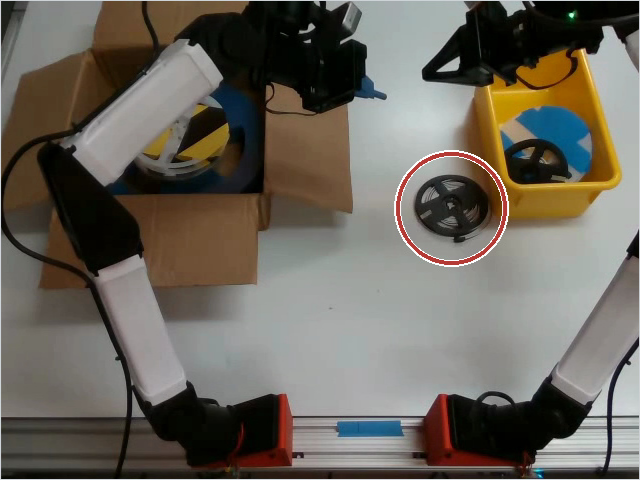
Dark reel on the table
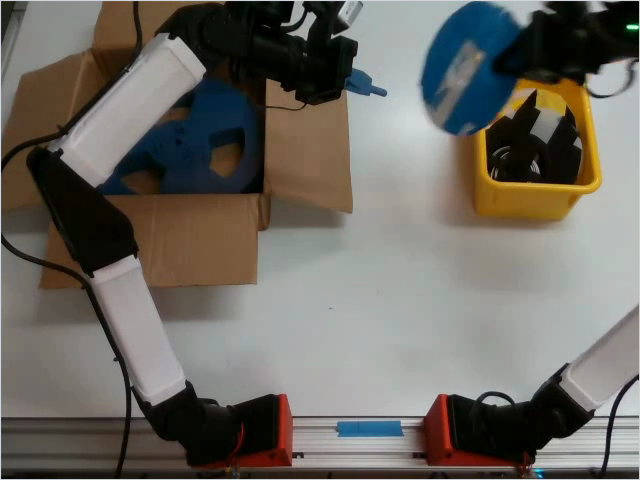
Blue reel moving toward the bin
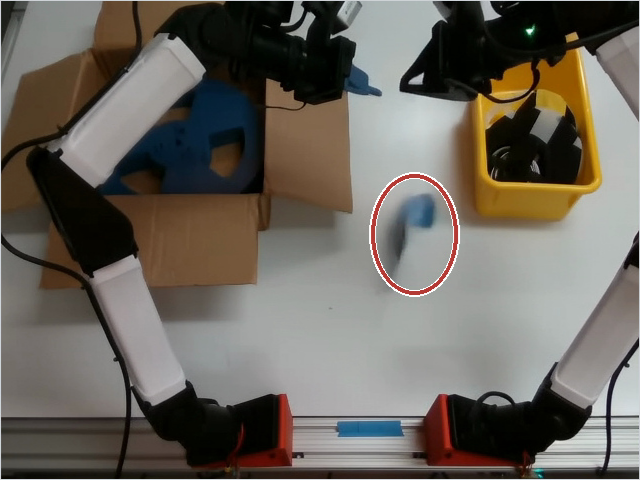
Blue reel falling outside the bin
At 2.0 s, the host still holds the reel while the generated reel is falling.
Selected frames from the paper, Figure 2FailureGen adapts Cosmos3-Nano to aligned robot video and motion, transfers failure-associated motion between compatible episodes, and labels the generated outcome.
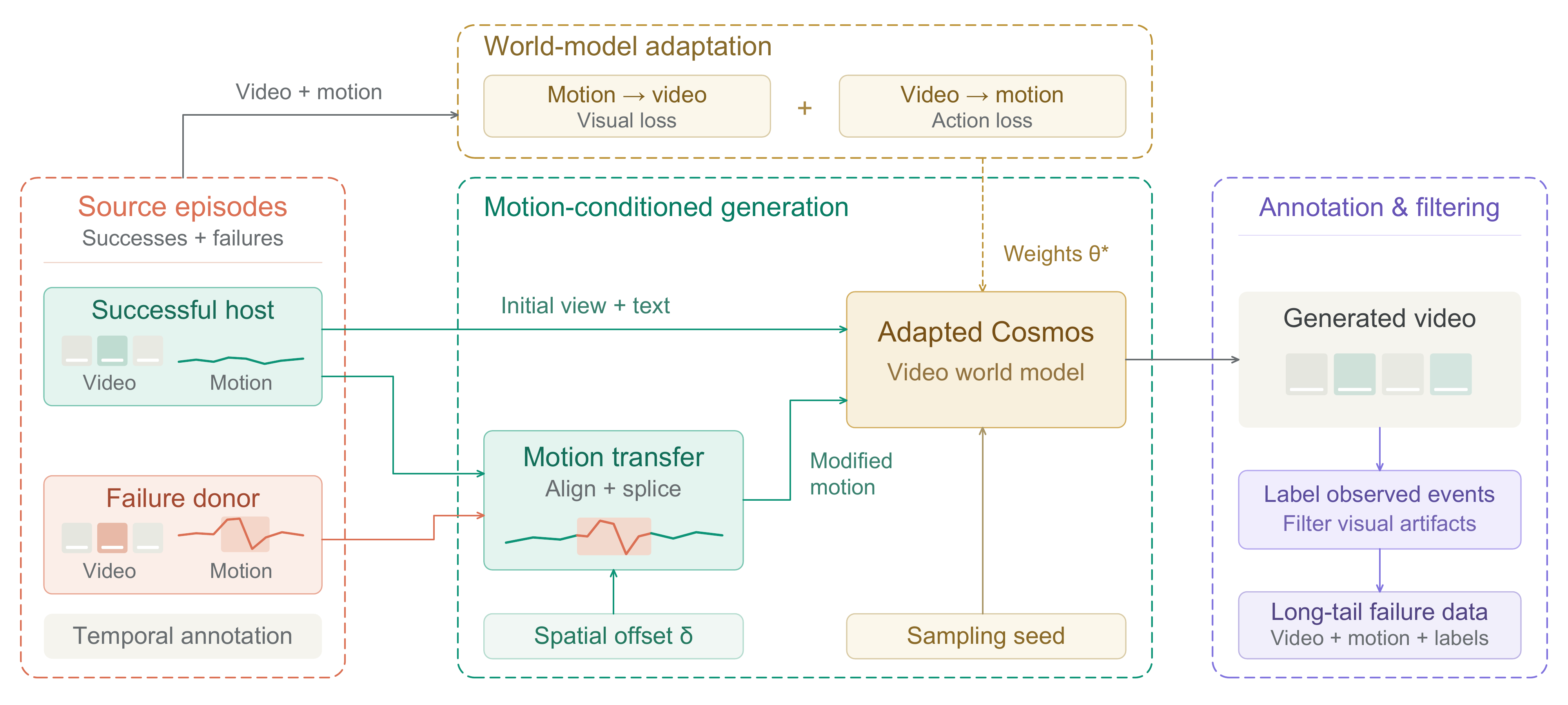
Use real successful and failed executions to learn forward and inverse dynamics from aligned video and robot motion.
Align a measured donor segment with a compatible host task step. Retain host conditioning outside the intervention and its transitions, and on unselected channels.
Generate a continuation, identify the events that actually occur, and filter unreliable clips. Retain motion, temporal labels, and source provenance.
A transferred failure can produce a different failure or a successful continuation. Labels describe the observed event, rather than assuming the intended outcome.
Visual failure detection is one downstream application. We evaluate augmentation in an industrial manipulation setting and on three ViFailback tasks.
A Cosmos3-Edge detector uses 66 real training episodes, with 75 generated clips added for augmentation. Evaluation uses a separate real recording session.
Preliminary comparison: sampling and training budgets differ. These results do not isolate the effect of augmentation alone.
Accuracy and failure recall improve in 5 of 6 model-task combinations. The remaining combination is unchanged.
| Task | Qwen3-VL-2B | Qwen3-VL-8B |
|---|---|---|
| Object into box | 94.1 → 100.0 | 98.5 → 100.0 |
| Vial / test-tube rack | 58.5 → 58.5 | 49.6 → 54.1 |
| Drawer / can | 84.4 → 97.0 | 94.8 → 97.0 |
Selected-task study. The paper includes additional transfer, replay, and host-motion controls.
Read the full method and experimental details, or explore the related tools for recording and annotating robot episodes.
@inproceedings{santhosh2026failuregen,
  title = {{FailureGen}: Scalable Robot Failure Data Generation with World Models},
  author = {Santhosh, Akul and Sathe, Chaitra and Jhunjhunwala, Aastha},
  booktitle = {``Oops, I erred'' Workshop at CoRL},
  year = {2026}
}